How Softgel Capsules Are Made: 7-Step Manufacturing Process
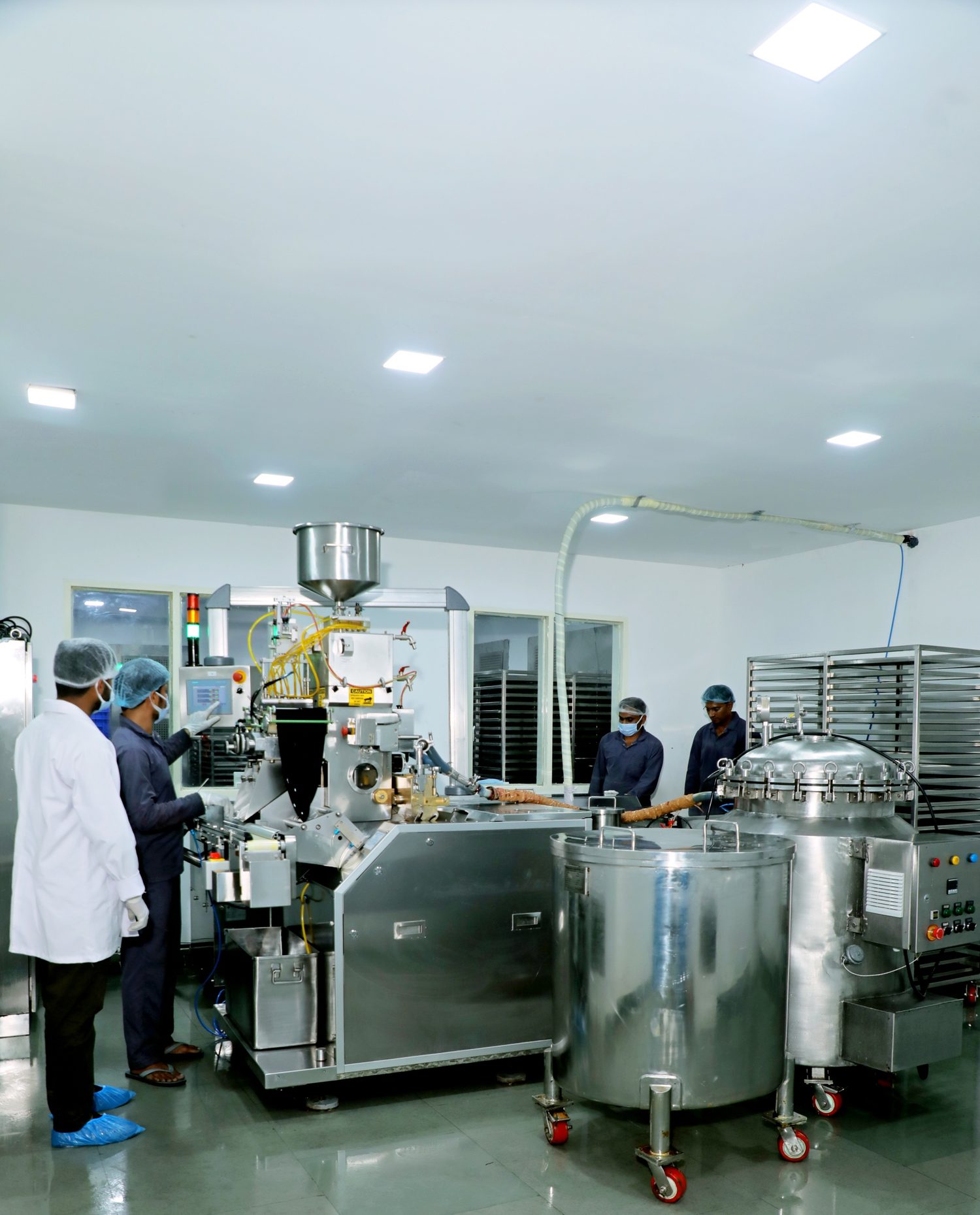
Inside a Modern Softgel Manufacturing Facility
Softgel capsule manufacturing is a precision operation that combines pharmaceutical-grade raw materials, specialised equipment, and rigorous quality control at every step. Unlike tablet pressing, which compresses dry powders, softgel production involves forming a gelatin shell and injecting a liquid fill simultaneously — a process that demands tight control of temperature, humidity, and timing. Here is how it works at Admetus Lifesciences, step by step.
Step 1: Raw Material Sourcing
Every production batch begins with incoming raw materials — pharmaceutical-grade gelatin, glycerin (plasticiser), purified water for the shell, and the active ingredient formulation for the fill. Gelatin is sourced from approved suppliers with full traceability documentation. Active ingredients (Cholecalciferol, Omega-3 concentrates, herbal oils, antioxidants) arrive with Certificates of Analysis from the supplier. All materials are quarantined in the raw material section until cleared by the quality team.
Step 2: Incoming Quality Control
The Quality Control (QC) laboratory tests every incoming material against its specification before it is released for production. Tests include identity confirmation, assay (potency), moisture content, microbial limits, heavy metals screening, and peroxide value (for oils). Only materials that pass all parameters are moved to the approved storage area. Rejected materials are segregated and returned or destroyed per standard operating procedure.
Step 3: Gelatin Mass Preparation
Approved gelatin, glycerin, and purified water are weighed and transferred to the gelatin preparation section. The ingredients are mixed in a jacketed melting vessel at controlled temperature (typically 60-70 degrees Celsius) until a homogeneous, bubble-free gelatin mass is formed. Colour and flavour are added at this stage if required. The molten gelatin is de-aerated under vacuum to remove trapped air, which would otherwise cause shell defects. The mass is then held in a temperature-controlled holding tank, ready to be cast into ribbons.
Step 4: Encapsulation (Rotary Die Process)
This is the core of softgel manufacturing. At Admetus Lifesciences, encapsulation is performed on the ARBES SGX-806P rotary die encapsulation machine. Molten gelatin is cast onto chilled drums to form two continuous gelatin ribbons. These ribbons converge at the rotary die, where precisely machined die cavities cut the capsule shape. Simultaneously, a positive-displacement pump injects the exact fill volume into each forming capsule. The die seals the two ribbon halves together, and the formed softgels drop onto a conveyor. Fill weight accuracy is monitored continuously — any deviation triggers an automatic alert.
Step 5: Drying
Freshly formed softgels contain excess moisture (typically 18-22% in the shell). Drying reduces this to the target specification of 6-10%. Capsules first pass through a tumble dryer (initial drying) and then enter drying tunnels where controlled airflow, temperature, and relative humidity remove moisture gradually over 24-72 hours. Rapid drying would cause shell cracking or shape distortion, so the process is carefully staged. Capsules are sampled at intervals to verify moisture content is converging to specification.
Step 6: Inspection and Quality Testing
Dried capsules undergo both visual inspection and laboratory testing. Visual inspection identifies cosmetic defects — misshapen capsules, leakers, twins (two capsules fused together), and colour inconsistencies. Laboratory QC tests the finished product for weight variation, disintegration time, dissolution profile, assay of active ingredient, and microbial limits. Only batches that meet all release specifications proceed to packaging.
Step 7: Packaging
Approved capsules are packed on the Elmach EPI 2000 automatic blister packing machine. The machine forms PVC/PVDC blister cavities, fills them with capsules, and heat-seals aluminium foil over the top. Each blister strip is printed with batch number, manufacturing date, expiry date, and barcode. Blisters are then cartoned, labelled, and palletised in the dispatch area. For export orders, additional documentation — Free Sale Certificate, Certificate of Analysis, Halal certificate — is prepared and included with the shipment.
Quality at Every Step
From incoming material testing to final release, the Admetus Lifesciences facility operates under FSSAI, GMP, HACCP, Halal, and WHO-GMP standards. Every batch is traceable from raw material lot to finished carton, ensuring full accountability and regulatory compliance for both domestic and international markets.
QUESTIONS
01How long does softgel manufacturing take from start to finish?
The typical production cycle from raw material receipt to finished-goods dispatch is 30-45 days. This includes quality testing of incoming materials (2-3 days), gelatin preparation and encapsulation (1-2 days), drying (24-72 hours), quality testing of finished product (3-5 days), and packaging.
02What equipment is used for softgel encapsulation?
At Admetus Lifesciences, encapsulation is performed on the ARBES SGX-806P rotary die machine, a precision German-engineered encapsulation line. Blister packaging uses the Elmach EPI 2000 automatic blister packing machine. Additional equipment includes gelatin melting vessels, tumble dryers, and drying tunnels.
03What quality tests are performed on finished softgels?
Finished softgels undergo weight variation testing, disintegration time, dissolution profile analysis, assay of active ingredient (potency), moisture content, and microbial limit testing. Visual inspection identifies cosmetic defects. Only batches meeting all release specifications are approved for dispatch.
NEED A MANUFACTURING PARTNER?
Contract manufacturing, private label, and export-ready softgel production. Quotation within 48 hours.
Request a Quote